
Introduction
Fracture of the Clavicle is among the most common skeletal injuries, particularly in children, young adults, and athletes. The clavicle plays a vital role in shoulder stability and upper limb movement; hence, its fracture can significantly affect arm function and daily activities. Early diagnosis and proper rehabilitation ensure optimal recovery.
Definition
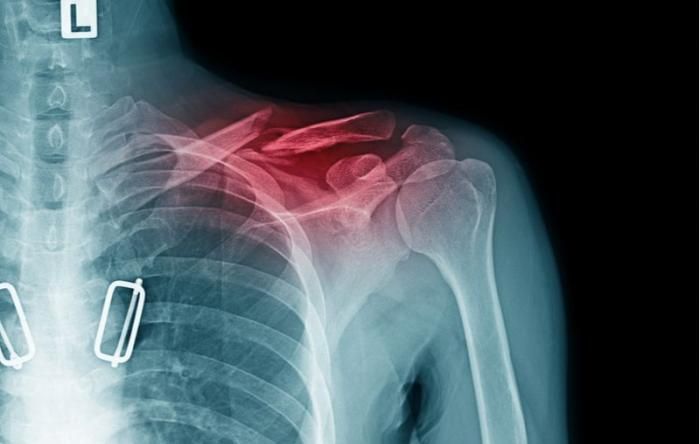
A clavicle fracture is a break or discontinuity in the collarbone, which connects the sternum (breastbone) to the scapula (shoulder blade). It commonly occurs in the middle third of the bone.
Mechanism of Injury
- Fall on an outstretched hand.
- Direct blow to the shoulder
- Road traffic accidents
- Sports-related trauma (contact sports, cycling)
- Birth trauma in newborns
Clinical Features
- Pain and tenderness over the clavicle
- Visible deformity or “step” sign
- Restricted shoulder movement
- Swelling and redness
- Patient supports the injured arm with the opposite hand.
- Crepitus on movement (occasionally)
Complications
- Malunion or non-union
- Shoulder stiffness
- Neurovascular injury (rare)
- Cosmetic deformity
- Chronic pain or weakness

Physiotherapy Management
- The primary objective is to regain the full active range of all shoulder complex movements.
- During immobilisation (first 3 weeks), to check the alignment of the fractured bone ends with immobilisation, confirm that the bandage in the axillae is not causing undue pressure on the brachial plexus, and when a figure-of-eight bandage is applied, make sure that it is holding the scapula in a properly braced-up position.
- Mobilisation(after 3 weeks) should be initiated in a small range; relaxed movements using Codman’s pendulum exercise regime, gradually increasing the range as further relaxation is achieved. If proper physiotherapeutic treatments are continued from the early stages, the results are excellent, and by 6 weeks, the patient should get back fully mobile and with a fairly strong shoulder.
Conclusion
Fracture of the Clavicle is a common yet manageable injury. With timely medical care and structured physiotherapy rehabilitation, most individuals regain full shoulder function and return to normal activities without long-term disability.
What is a clavicle fracture and who is most commonly affected?
Answer: A clavicle fracture is a break in the collarbone, commonly affecting children, young adults, and athletes due to its role in shoulder stability.
What are common signs and symptoms of a clavicle fracture?
Answer: Key symptoms include pain, tenderness, visible deformity, restricted shoulder movement, swelling, and the patient supporting the injured arm.
How does physiotherapy help in clavicle fracture recovery
Answer: Physiotherapy restores shoulder mobility through early alignment checks during immobilisation and gradual mobilisation with exercises like Codman’s pendulum after 3 weeks.