Introduction
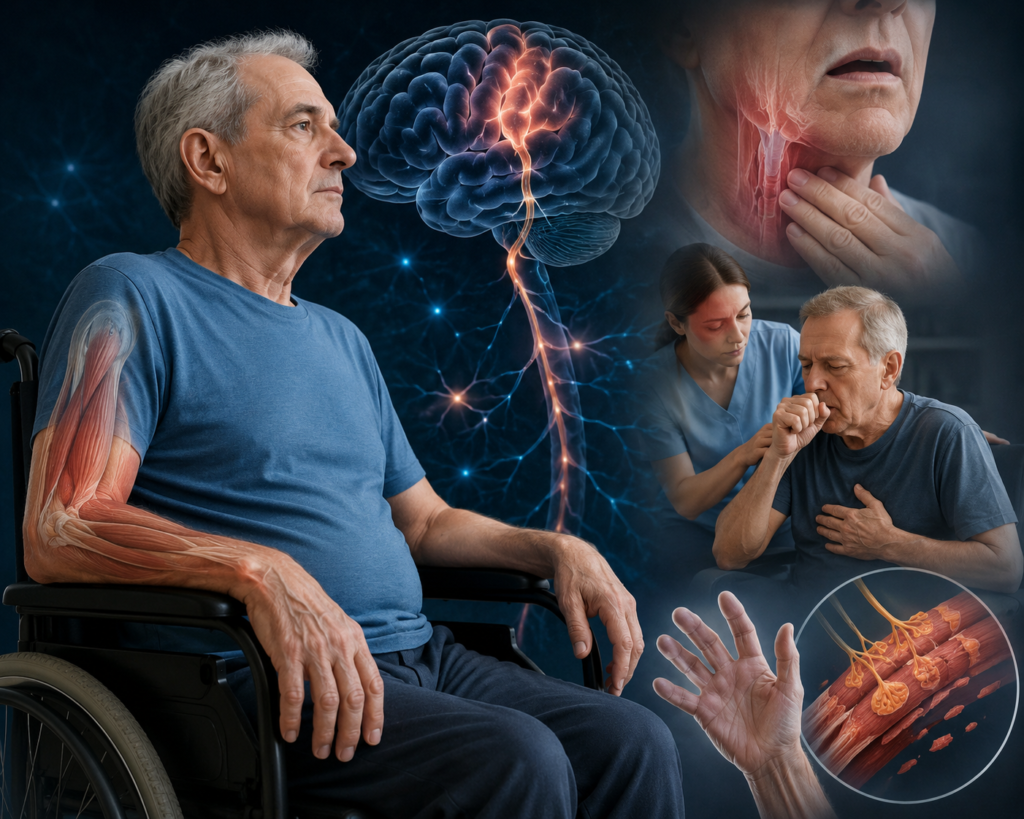
- Lou Gehrig’s disease, is a progressive neurological disorder affecting the motor neurons responsible for voluntary muscle movement.
- The condition gradually decreased muscle strength and mobility and can eventually affect speech, swallowing, and breathing.
Definition
- Lou Gehrig’s disease is a neurodegenerative motor neuron disease involving both upper and lower motor neurons.
- Progressive loss of these nerve cells prevents normal communication between the brain, spinal cord, and muscles, resulting in weakness, muscle wasting, and paralysis.
Etiology
- The exact cause of most Lou Gehrig’s disease cases remains unknown.
- Approximately 5–10% of cases are familial and associated with inherited genetic changes.
- Researchers are investigating genetic susceptibility and possible environmental factors, but no single environmental cause has been confirmed for most cases.
Clinical Feature
- Progressive, usually asymmetric muscle weakness.
- Both upper and lower motor neuron signs may occur.
- Spasticity and abnormal reflexes may develop.
- Muscle wasting and fasciculations are common.
- Bulbar involvement can cause speech and swallowing difficulties.
- Respiratory muscle weakness generally develops as the disease advances.
Sign and Symptoms
- Muscle weakness, commonly beginning in the hands, arms, legs, or swallowing muscles.
- Stiffness and spasticity.
- Muscle cramps and twitching.
- Difficulty walking, climbing stairs, or performing daily activities.
- Slurred speech or difficulty swallowing.
- Fatigue and decreased physical endurance.
- Progressive breathing difficulty.
- Some individuals may develop cognitive or behavioral changes.

Physiotherapy Management
- Perform regular assessment of strength, mobility, balance, gait, fatigue, and functional ability.
- Use individualized, low-to-moderate intensity exercise without excessive fatigue.
- Provide gentle range-of-motion and stretching exercises to maintain joint mobility and decreased contracture risk.
- Use positioning techniques to improve comfort and prevent deformity.
- Introduce gait training and appropriate assistive devices when required.
- Provide balance and fall-prevention strategies.
- Educate patients and caregivers about energy conservation and safe transfers.
- Coordinate with occupational, speech, respiratory, nutritional, and medical professionals as part of multidisciplinary care.
Complication
- Progressive paralysis and loss of independence.
- Joint stiffness and contractures.
- Falls, pain, and pressure injuries.
- Speech and communication impairment.
- Difficulty swallowing and nutritional problems.
- Respiratory muscle weakness and respiratory failure.
- Venous thromboembolic complications may occur with severe immobility.
Risk Factors
- Increasing age is an important risk factor.
- Male sex has been associated with a somewhat higher occurrence, particularly in earlier epidemiological studies.
- Certain occupational or environmental exposures have been investigated, but definite causes remain uncertain for most patients.
Conclusion
- Lou Gehrig’s disease is a progressive condition requiring individualized and multidisciplinary management.
- Although physiotherapy cannot stop motor neuron degeneration, appropriate rehabilitation can help maintain mobility, joint function, comfort, safety, and independence for as long as possible.
- Regular reassessment and timely adaptation of therapy are essential as functional abilities change.
What is Lou Gehrig’s disease?
Answer: Lou Gehrig’s disease is a progressive motor neuron disease that causes muscle weakness, wasting, and eventually paralysis.
What are common symptoms of Lou Gehrig’s disease?
Answer: Common symptoms include muscle weakness, stiffness, twitching, cramps, difficulty walking, speech or swallowing problems, and breathing difficulties.
How does physiotherapy help in Lou Gehrig’s disease?
Answer: Physiotherapy helps maintain mobility, joint flexibility, balance, comfort, and functional independence through gentle exercises, stretching, gait training, and energy-conservation strategies.
Need Personalized Guidance for Physiotherapy?
Our senior certified therapists at Aaziban Care Center provide customized 1-on-1 evaluation and treatment plans at our care centers.