

You eagerly wait for your child’s first words. Every smile, sound, and little attempt to communicate feels like a precious milestone. But when other children begin talking and your child is still struggling to express themselves, you may wonder, “Could this be Late Language Emergence, and why isn’t my child speaking yet?”
If these thoughts have crossed your mind, you’re not alone. Many parents worry when their toddler seems slower to talk than other children. In many cases, the reason may be Late Language Emergence (LLE)—a delay in developing speech and language skills during the early years.
Let’s walk through it together.
Is Your Child a Late Talker or Is It More Than That?
Imagine two children who are both two years old.
One child says only a handful of words but happily points to toys, follows instructions, laughs with family, and understands almost everything that is said.
The other child rarely speaks, struggles to understand simple directions, and finds it difficult to communicate even with gestures.
Although both children may appear to be “late talkers,” their needs may be very different.
When Should Your Child Start Talking?
A late talker is a child, usually between 18 and 30 months, who speaks fewer words than expected but is otherwise developing well.
Your child may:
- Understand what you say.
- Make eye contact.
- Point to objects they want.
- Enjoy playing with others.
- Learn new skills normally.
Many late talkers gradually catch up with their peers.
What Is a Language Delay?
A language delay affects more than just speaking.
Your child may also have difficulty:
- Understanding simple words or instructions.
- Learning new vocabulary.
- Putting words together.
- Expressing needs and feelings.
This type of delay often benefits from early speech and language therapy.
When Should a Child Start Talking?
Children don’t all begin speaking on the same day or even in the same month. However, there are general milestones that help parents understand typical language development.
Around 6 Months
Your baby may:
- Babble with sounds like “ba-ba” or “da-da.”
- Smile during conversations.
- Respond to familiar voices.
Around 12 Months
Your child may:
- Say simple words such as “Mama” or “Dada.”
- Respond to their name.
- Wave goodbye.
- Point to objects they want.
Around 18 Months
Most toddlers:
- Use around 20 to 50 words.
- Follow simple directions.
- Name familiar people or objects.
Around 2 Years
Children usually:
- Have at least 50 spoken words.
- Combine two words like “more milk” or “Daddy come.”
- Ask for things using words.
Around 3 Years
Many children:
- Speak in short sentences.
- Tell simple stories.
- Ask lots of questions.
- Can be understood by family members most of the time.
If your child reaches these milestones a little later, it doesn’t automatically mean something is wrong. However, large delays deserve attention.
Early Warning Signs of Language Delay
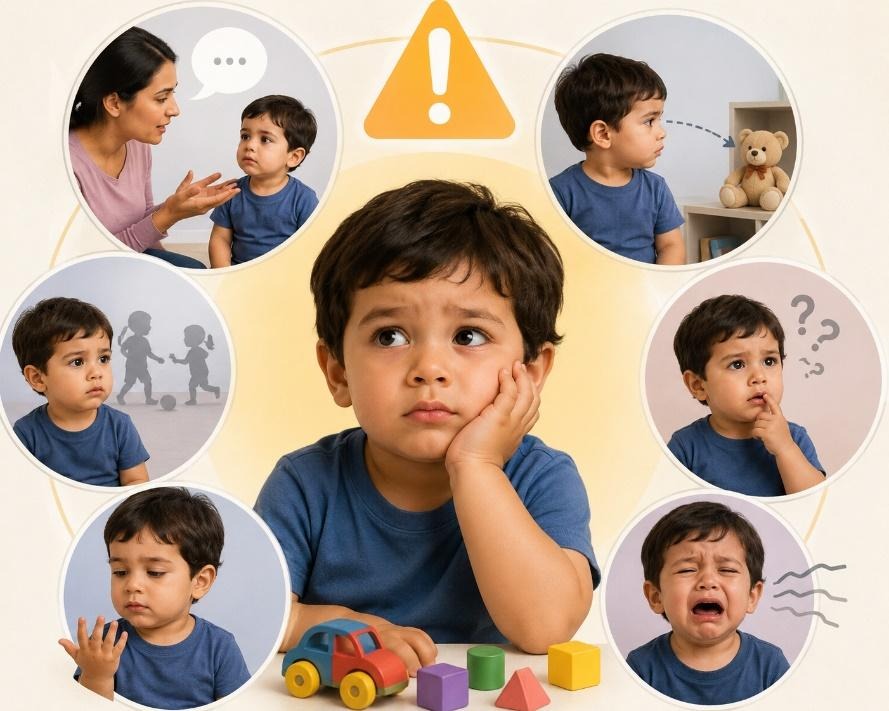
As a parent, you know your child better than anyone else. Trust your instincts if you notice that your child:
- Rarely babbles by their first birthday.
- Doesn’t point, wave, or use gestures.
- Says very few words by 18 months.
- Isn’t combining two words by age two.
- Doesn’t understand simple requests like “Come here.”
- Rarely imitates sounds or words.
- Gets frustrated because they cannot communicate.
- Stops using words they previously knew.
You don’t have to wait until your child is older to ask for help. Early evaluation simply gives you more information and more options.
What Can Affect Your Child’s Language Development?
There isn’t always one clear reason why a child develops language more slowly.Several factors may play a role.
- Hearing Ability
Children learn language by listening.
Frequent ear infections or hearing difficulties may make it harder for them to hear speech clearly.
- Family Interaction
Children learn words through everyday conversations.
Talking during meals, bath time, playtime, and bedtime builds language naturally.
- Family History
Some children have relatives who also spoke later than expected.
- Developmental Conditions
Sometimes delayed language is linked with conditions such as Autism Spectrum Disorder (ASD) or Developmental Language Disorder (DLD).
- Premature Birth
Babies born early may need a little extra time to reach developmental milestones.
Remember, having one or more of these factors doesn’t mean your child will definitely have a language disorder.
Activities That Encourage Language Growth
The wonderful thing about language development is that learning happens during everyday moments.
You don’t need expensive toys or special lessons.
Instead, try these simple activities:
- Read picture books together every day.
- Talk about everything you’re doing.
- Name objects around your home.
- Sing nursery rhymes and action songs.
- Play pretend games together.
- Encourage your child to make choices using words or gestures.
- Wait patiently after asking a question so your child has time to respond.
- Celebrate every communication attempt—even if it isn’t a perfect word.
The more your child hears language used in loving, meaningful interactions, the more opportunities they have to learn.
Common Myths About Late Talking—Busted!

Many parents receive advice from family and friends. While usually well-intended, some common beliefs can delay getting the right support.
Myth: “Boys always talk late.”
Reality: Some boys develop language a little later than girls, but significant delays should still be evaluated.
Myth: “My child will grow out of it.”
Reality: Some children do catch up naturally, but others benefit greatly from early intervention.
Myth: “Watching educational videos teaches children to talk.”
Reality: Children learn language best through real conversations with people who respond to them.
Myth: “Talking for your child makes life easier.”
Reality: Giving your child opportunities to communicate helps build confidence and language skills.
| When Is It Time to Seek Professional Help? |
If you’re wondering whether it’s the right time to seek help, remember this:
You never lose anything by asking questions early. Consider speaking with a speech-language pathologist if your child:
- Has no meaningful words by 18 months.
- Doesn’t combine words by age two.
- Doesn’t seem to understand simple instructions.
- Becomes very frustrated while trying to communicate.
- Shows little improvement over several months.
Early support can make communication easier, reduce frustration, and improve future learning.
The Role of Parents in Language Development
You are your child’s first and most important teacher. The conversations you have every day—even simple ones—help build language.
You can support your child’s development by:
- Talking while cooking or shopping.
- Reading together every day.
- Listening patiently.
- Expanding on what your child says.
- Encouraging turn-taking during conversations.
- Playing together without distractions.
Your child doesn’t need perfect lessons.
Can Screen Time Affect Your Child’s Speech?

Screens are now part of everyday life, but too much screen time can reduce opportunities for real conversation.
Young children learn language through face-to-face interaction, not simply by hearing words on a screen.
To encourage healthy language development:
- Limit passive screen time, especially before age two.
- Choose interactive activities whenever possible.
- Watch programs together instead of leaving children alone with a device.
- Talk about what you see on the screen.
A five-minute conversation often teaches more language than a much longer period of passive viewing.
Late Language Emergence (LLE) vs. Developmental Language Disorder (DLD): What’s the Difference?
Late Language Emergence (LLE) and Developmental Language Disorder (DLD) are related but not the same.
Children with LLE start talking later than expected. Many eventually catch up, especially with encouragement and, when needed, early support.
Children with DLD continue to experience ongoing difficulties understanding and using language as they grow. These challenges often continue into school years and usually require ongoing speech-language therapy.
Only a qualified professional can determine whether your child is simply a late talker or has a more persistent language difficulty.
Final Thoughts
If your child isn’t talking as much as you expected, it’s natural to feel worried. But remember—a delay in language is not a measure of your child’s intelligence, personality, or future potential.
Many children with Late Language Emergence grow into confident communicators with early guidance, patient encouragement, and supportive families.
At Aaziban, we believe every child deserves the opportunity to communicate with confidence. Through personalized speech and language therapy and family-centered support, we work alongside parents to help children develop the communication skills they need to thrive.
Your voice, your conversations, and your everyday interactions matter more than you may realize. Reading together, singing songs, describing daily activities, and simply listening to your child all help build the foundation for language.
Above all, remember this: every child has their own path, and with love, patience, and the right support, many children with Late Language Emergence go on to communicate, learn, and connect with the world in their own wonderful way.
1. What is Late Language Emergence (LLE)?
Late Language Emergence (LLE) is when a child between 18 and 30 months has fewer spoken words than expected but is otherwise developing typically in areas such as play, social interaction, and understanding.
2. When should I worry about my child’s speech delay?
You should consider seeking professional advice if your child has no meaningful words by 18 months, is not combining two words by age 2, or has difficulty understanding simple instructions.
3. Can a child with Late Language Emergence catch up?
Yes. Many children with LLE catch up to their peers, especially with regular language-rich interactions at home and, when needed, early speech and language therapy.
4. How can parents help a child with Late Language Emergence?
Parents can encourage language development by talking with their child throughout the day, reading books together, singing songs, playing interactive games, and giving the child plenty of opportunities to communicate.
Need Personalized Guidance for Speech Therapy?
Our senior certified therapists at Aaziban Care Center provide customized 1-on-1 evaluation and treatment plans at our care centers.